
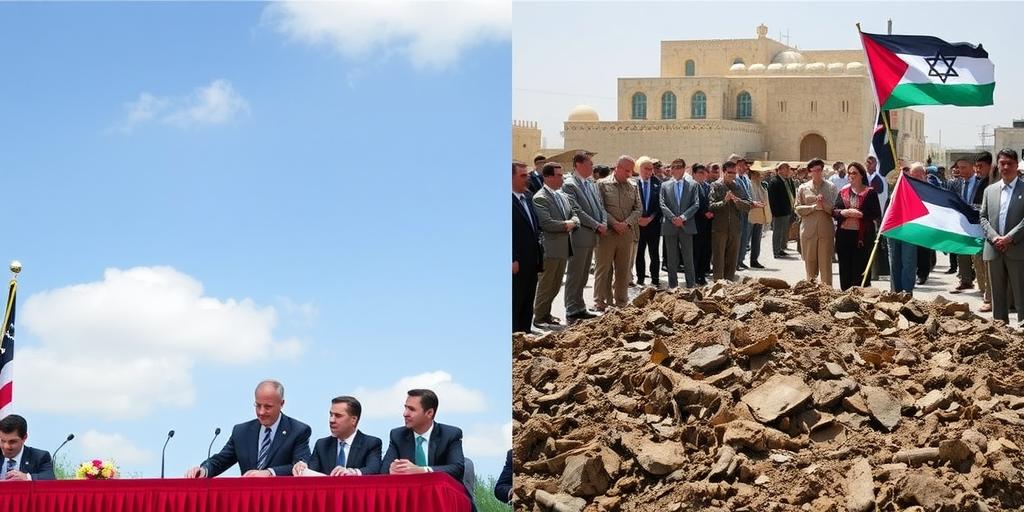
Revisiting the Oslo Accords: Why Did Israeli-Palestinian Peace Fail?
The Oslo Accords, signed in the 1990s, were a series of agreements between Israel and the Palestine Liberation Organization (PLO) intended to bring about a peaceful resolution to the Israeli-Palestinian conflict. These accords envisioned a two-state solution, with an independent Palestinian state existing alongside Israel. However, the promise of Oslo remains unfulfilled. This post examines the key factors contributing to the failure of the Oslo Accords and the persistent lack of peace.
The Promise of Oslo
The Oslo Accords, comprised primarily of Oslo I (1993) and Oslo II (1995), established a framework for interim Palestinian self-governance in parts of the West Bank and Gaza Strip. Key elements included:
- Mutual Recognition: Israel recognized the PLO as the representative of the Palestinian people, and the PLO recognized Israel's right to exist.
- Interim Self-Government: The establishment of the Palestinian Authority (PA) to govern specified areas.
- Negotiations on Final Status Issues: Deferring the most contentious issues – borders, Jerusalem, refugees, and settlements – for final status negotiations.
Factors Contributing to the Failure
Several factors undermined the Oslo Accords and led to their ultimate failure:
Unresolved Final Status Issues: The failure to reach agreement on the core issues of borders, Jerusalem, refugees, and settlements proved to be a major stumbling block. Both sides held firm to their positions, making compromise difficult.
Settlement Expansion: Israel's continued expansion of settlements in the West Bank was a significant source of friction. Palestinians viewed settlement construction as a violation of the spirit of Oslo and a pre-judgment of final borders.
Violence and Security Concerns: A cycle of violence, including suicide bombings by Palestinian militant groups and Israeli military operations, eroded trust and made negotiations more difficult. Each side blamed the other for failing to control violence.
Weak Palestinian Governance: The Palestinian Authority faced challenges in establishing effective governance, combating corruption, and maintaining security. This weakness undermined its credibility as a negotiating partner.
Lack of Full Israeli Commitment: Critics argue that Israel never fully committed to the two-state solution envisioned by Oslo, pointing to continued occupation and settlement expansion.
Regional and International Dynamics: Regional instability and shifting international priorities also played a role. The rise of Hamas, the Second Intifada, and the aftermath of 9/11 created a less conducive environment for peace.
The Current Situation
Today, the Oslo Accords are largely considered defunct. The two-state solution remains elusive, and the Israeli-Palestinian conflict persists. The lack of progress has led to increased frustration and despair on both sides. The expansion of Israeli settlements, the ongoing occupation of the West Bank, and the divisions within Palestinian society continue to be major obstacles to peace.
Conclusion
The failure of the Oslo Accords is a complex and tragic story. While the accords initially offered hope for a peaceful resolution, unresolved issues, violence, and a lack of full commitment from both sides ultimately led to their collapse. Moving forward requires a renewed effort to address the core issues of the conflict and a willingness from both Israelis and Palestinians to make difficult compromises for the sake of a lasting peace.


