
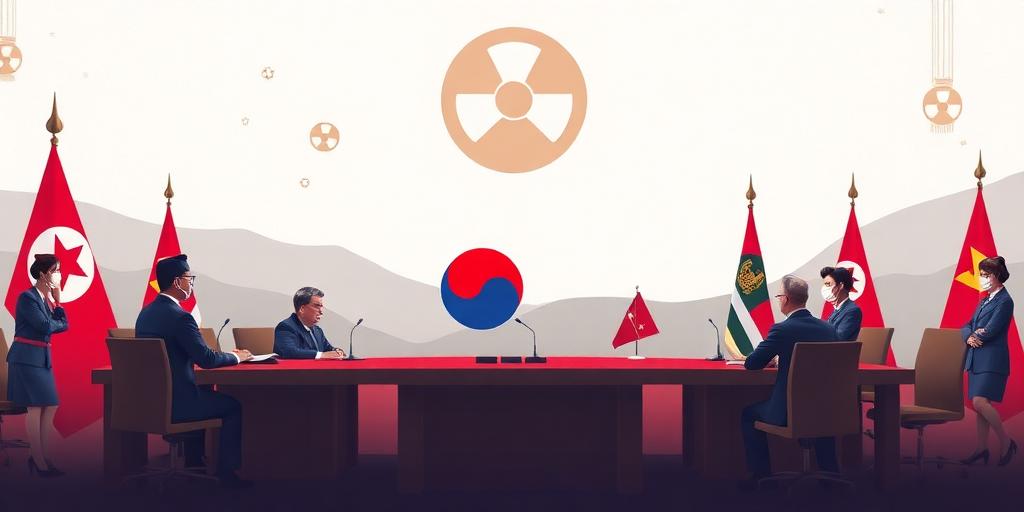
Korean Peninsula Denuclearization Talks: A History of Failed Attempts
The Korean Peninsula has been a focal point of international concern for decades due to the Democratic People's Republic of Korea's (DPRK) nuclear ambitions. Numerous attempts at denuclearization talks have taken place, each with varying degrees of initial optimism, but ultimately ending in stalemate or failure. This post examines the history of these talks, highlighting key milestones, challenges, and reasons for their lack of success.
Early Engagement and the Agreed Framework (1990s)
The first significant diplomatic efforts to address North Korea's nuclear program began in the early 1990s. The primary concern stemmed from the DPRK's withdrawal from the Nuclear Non-Proliferation Treaty (NPT) in 1993. This crisis led to direct negotiations between the United States and North Korea, resulting in the 1994 Agreed Framework.
Under the Agreed Framework, North Korea pledged to freeze and eventually dismantle its graphite-moderated reactors and related facilities, which were suspected of being used for plutonium production. In return, the United States committed to providing North Korea with two light-water reactors (LWRs) for civilian energy purposes and interim heavy fuel oil supplies.
Challenges and Collapse: The Agreed Framework faced numerous challenges from the outset. Delays in the construction of the LWRs and suspicions of North Korea pursuing a secret uranium enrichment program led to the eventual collapse of the agreement in 2002. The Bush administration's hard-line stance and inclusion of North Korea in the "Axis of Evil" further strained relations.
The Six-Party Talks (2003-2009)
Following the collapse of the Agreed Framework, a new multilateral effort emerged in 2003: the Six-Party Talks. These talks involved North Korea, South Korea, the United States, China, Russia, and Japan. The primary goal remained the complete, verifiable, and irreversible denuclearization of the Korean Peninsula.
Progress and Setbacks: The Six-Party Talks saw some initial progress. In 2005, North Korea agreed to abandon all nuclear weapons and existing nuclear programs. In return, the other parties pledged to provide security assurances, energy assistance, and normalization of relations. However, this progress was short-lived.
North Korea continued to conduct nuclear tests in 2006 and 2009, violating UN Security Council resolutions and undermining the credibility of the talks. Disagreements over verification methods and the sequencing of steps also contributed to the deadlock. The Six-Party Talks effectively stalled after 2009.
Bilateral Negotiations and Summits (2010s)
In the 2010s, various attempts were made to revive dialogue through bilateral negotiations and high-level summits. The Obama administration pursued a policy of "strategic patience," combining sanctions with occasional diplomatic outreach. However, North Korea continued to advance its nuclear and missile capabilities.
The Trump Era: The Trump administration initially adopted a policy of "maximum pressure," increasing sanctions and military threats. However, in a surprise move, President Trump engaged in direct diplomacy with North Korean leader Kim Jong-un. Three summits took place between 2018 and 2019, in Singapore, Hanoi, and Panmunjom.
While the summits generated significant media attention and lowered tensions, they failed to produce any concrete agreements on denuclearization. The Hanoi summit in 2019 ended abruptly due to disagreements over the scope of denuclearization measures and sanctions relief. The Trump administration's approach was criticized for prioritizing personal diplomacy over detailed negotiations and verification mechanisms.
Current Status and Future Prospects
As of 2023, denuclearization talks remain stalled. North Korea has continued to develop and test nuclear weapons and ballistic missiles, demonstrating its resolve to maintain its nuclear arsenal. The Biden administration has expressed willingness to engage in diplomacy with North Korea without preconditions, but Pyongyang has so far shown little interest.
The history of failed denuclearization talks highlights the complexity and intractability of the issue. Key challenges include:
- Lack of Trust: Deep-seated mistrust between North Korea and the United States.
- Verification Issues: Difficulties in verifying North Korea's nuclear activities.
- Security Concerns: North Korea's perception of external threats and its desire for security guarantees.
- Sanctions Relief: Disagreements over the timing and scope of sanctions relief.
- Internal Politics: Domestic political considerations in both North Korea and the United States.
Looking ahead, a comprehensive and sustained diplomatic effort is needed to address these challenges. This will require a combination of incentives, pressure, and a willingness to compromise. The involvement of all relevant stakeholders, including China, South Korea, Japan, and Russia, is essential. The path to denuclearization will be long and arduous, but the stakes are too high to abandon the pursuit of a peaceful resolution.
Conclusion
The history of Korean Peninsula denuclearization talks is marked by repeated cycles of hope and disappointment. Despite numerous attempts and varying approaches, a lasting solution remains elusive. Understanding the history of these failed attempts is crucial for informing future strategies and policies aimed at achieving denuclearization and promoting peace and stability in the region.


