
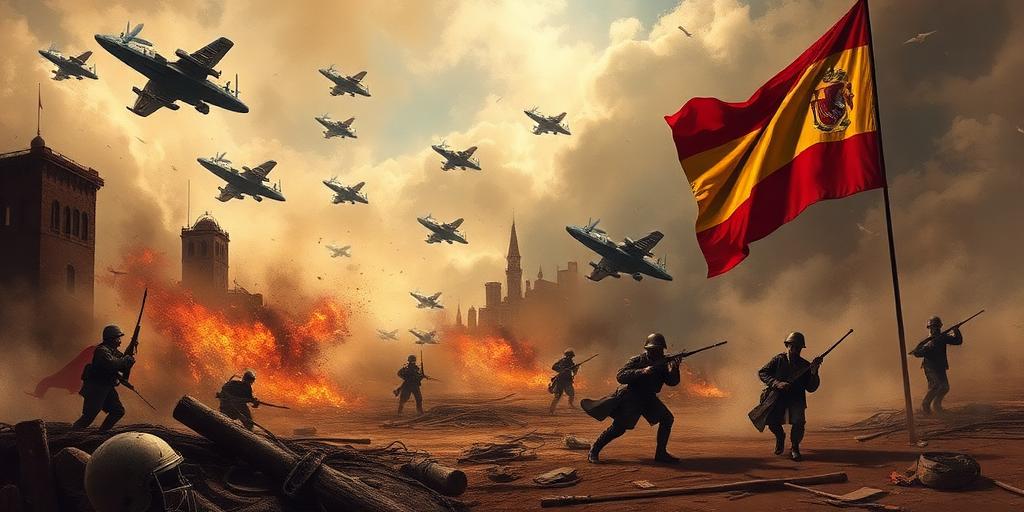
The Spanish Civil War: A Dress Rehearsal for Global Conflict
The Spanish Civil War, fought from 1936 to 1939, is often viewed as a prelude to World War II. It served as a testing ground for military tactics and technologies that would later be deployed on a much larger scale. This conflict pitted the Republican faction, which supported the Second Spanish Republic, against the Nationalist faction, a rebel group led by General Francisco Franco. The war attracted international attention and involvement, making it a significant event in the lead-up to the global conflict.
Key Players and Ideologies
The Republican side included a broad coalition of socialists, communists, anarchists, and those loyal to the elected government. They sought to defend the Republic against the rising tide of fascism. The Nationalist side, composed of monarchists, conservatives, and the fascist Falange, aimed to overthrow the Republic and establish an authoritarian regime.
Both sides received support from foreign powers, turning the Spanish Civil War into a proxy conflict. Nazi Germany and Fascist Italy provided substantial military aid to the Nationalists, while the Soviet Union supported the Republicans. This foreign intervention not only prolonged the war but also allowed these powers to test new military strategies and equipment.
Military Innovations and Tactics
The Spanish Civil War saw the introduction and refinement of several military innovations:
- Aerial Bombardment: The German Luftwaffe and the Italian Aviazione Legionaria used the conflict to test the effectiveness of aerial bombing. The bombing of Guernica, a Basque town, by the Luftwaffe in 1937, became a symbol of the war's brutality and the indiscriminate nature of aerial warfare.
- Tank Warfare: Both sides utilized tanks, with the Nationalists benefiting from superior German Panzer tanks. The war provided valuable lessons in tank tactics and armored warfare, which would be crucial in World War II.
- Combined Arms Tactics: The integration of air power, tanks, and infantry was tested and refined during the conflict. The Nationalists, with German support, developed more effective combined arms strategies.
- Propaganda and Psychological Warfare: Both sides used propaganda to sway public opinion and undermine enemy morale. The war demonstrated the power of propaganda in shaping perceptions and mobilizing support.
International Impact and Alliances
The war highlighted the growing divisions in Europe and the failure of international diplomacy to prevent conflict. The non-intervention policy adopted by Britain and France allowed Germany and Italy to provide unchecked support to the Nationalists, emboldening the fascist powers. The involvement of the Soviet Union on the Republican side further deepened the ideological divide.
The Spanish Civil War also served as a training ground for future military leaders and strategists. Many individuals who fought in Spain later played significant roles in World War II. The lessons learned in Spain influenced military thinking and preparations for the larger conflict that was to come.
The Legacy of the Spanish Civil War
In conclusion, the Spanish Civil War was more than just a local conflict; it was a crucial precursor to World War II. It provided a testing ground for military tactics, technologies, and ideologies that would shape the global conflict. The war also exposed the weaknesses of international diplomacy and the growing threat of fascism. Understanding the Spanish Civil War is essential for comprehending the dynamics that led to World War II and the profound impact it had on the 20th century.


