
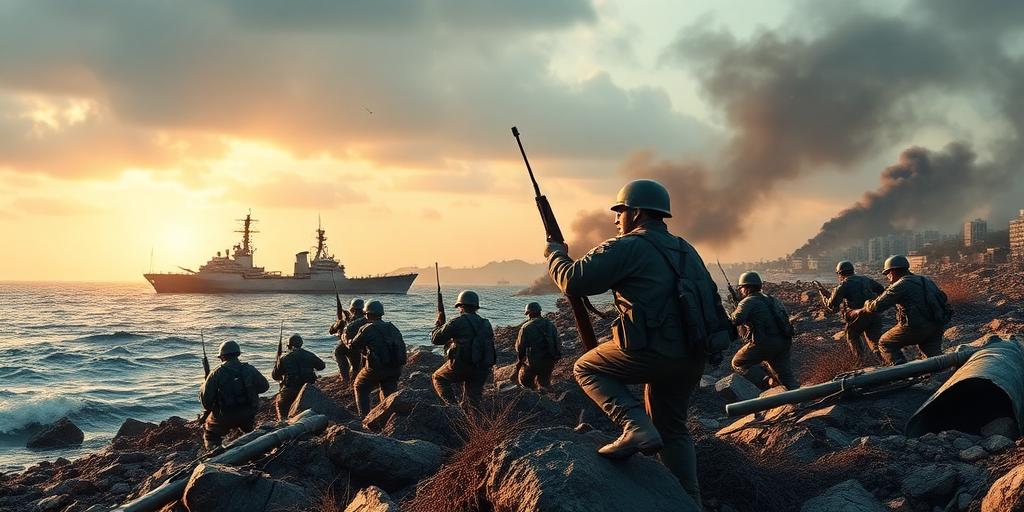
The Inchon Landing, codenamed Operation Chromite, remains one of the most audacious and strategically significant military operations in modern history. Conceived by General Douglas MacArthur, the landing on September 15, 1950, aimed to reverse the disastrous early months of the Korean War, where North Korean forces had pushed the South Korean and United Nations troops to the brink of defeat.
Background to the Brink: By the summer of 1950, the Korean Peninsula was in crisis. The North Korean People's Army (NKPA) had surged south, capturing Seoul and driving the Republic of Korea Army (ROK) and the U.N. forces into a small defensive perimeter around Pusan. The situation was dire, with the potential for the complete collapse of South Korea seeming imminent.
MacArthur's Bold Gamble: In the face of this crisis, General MacArthur proposed a daring amphibious assault far behind enemy lines at Inchon, near Seoul. The plan was fraught with risks. Inchon's natural conditions were notoriously challenging: narrow channels, strong currents, and extreme tidal variations. Military experts considered the landing highly dangerous, yet MacArthur was convinced that its audacity would catch the enemy off guard and sever their supply lines.
Planning and Preparation: The planning for Operation Chromite was meticulous, involving extensive hydrographic surveys and intelligence gathering. The landing force, composed primarily of U.S. Marines, underwent intensive training. Logistical challenges were immense, requiring the coordination of naval, air, and ground assets. Despite skepticism from the Joint Chiefs of Staff, MacArthur's forceful advocacy secured the necessary resources.
Execution and Breakthrough: The landing commenced on September 15. The 1st Marine Regiment secured Wolmi-do Island, dominating the approach to Inchon. The main assault followed, facing fierce resistance. The Marines fought their way through the city, overcoming fortified positions and determined defenders. The surprise and speed of the operation disrupted North Korean supply lines and communications, causing chaos and disarray.
Strategic Impact: The Inchon Landing had a transformative impact on the Korean War. It outflanked the North Korean forces, forcing them to retreat northward. Seoul was recaptured, and the U.N. forces regained the strategic initiative. The landing turned the tide of the war, shifting from a desperate defense to a counteroffensive that pushed deep into North Korea. However, it also led to the later intervention of Chinese forces, prolonging the conflict.
Controversies and Legacy: Despite its success, the Inchon Landing remains a subject of debate. Critics point to the high risks involved and the potential for catastrophic failure. Others question MacArthur's leadership style and his disregard for dissenting opinions. Nevertheless, the Inchon Landing stands as a testament to the power of bold strategy and decisive action. It is studied in military academies worldwide as a classic example of amphibious warfare and a pivotal moment in the Korean War.


