
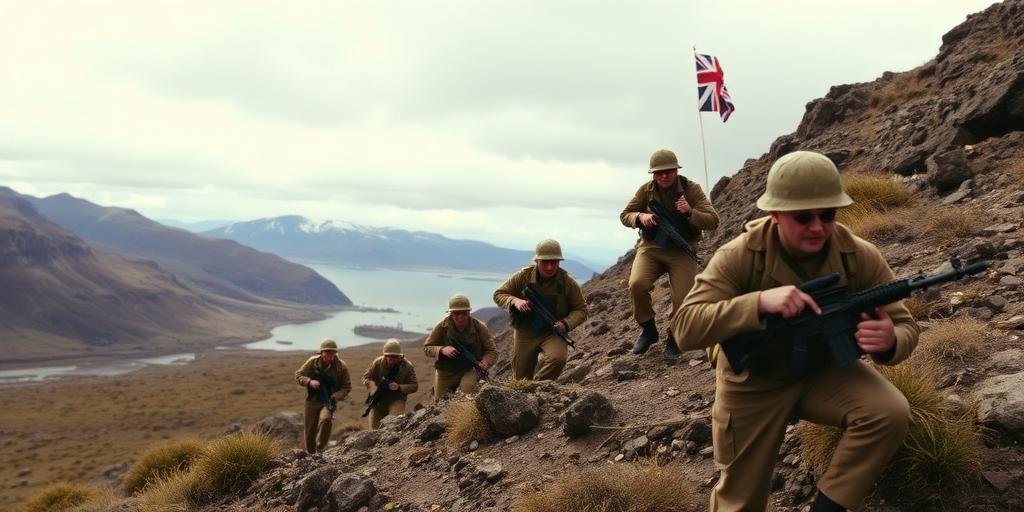
The Falklands War, a brief but impactful conflict in 1982, remains a significant event in modern history. It pitted the United Kingdom against Argentina in a battle for control over the Falkland Islands, a remote archipelago in the South Atlantic. This post will explore the key factors that led to the war, the major events that unfolded, and the lasting consequences of the conflict.
Background to the Conflict The Falkland Islands, known as Islas Malvinas in Argentina, have been a point of contention between the two nations for centuries. Argentina claimed sovereignty over the islands, asserting that they were inherited from Spain after its independence. The United Kingdom, however, based its claim on continuous administration of the islands since 1833 and the principle of self-determination for the islanders, who overwhelmingly desired to remain British.
Argentina's Miscalculation In the early 1980s, Argentina was under the rule of a military junta facing increasing domestic unrest and economic challenges. The decision to invade the Falkland Islands on April 2, 1982, was, in part, a gamble to divert public attention from internal problems and rally nationalistic fervor. The Argentine government believed that the UK, burdened by economic issues and a perceived lack of interest in the distant islands, would not mount a significant military response.
This proved to be a grave miscalculation. The Argentine military, while possessing modern equipment, lacked the training and logistical capabilities to sustain a prolonged campaign against a determined and technologically superior opponent.
Thatcher's Gamble Margaret Thatcher, the Prime Minister of the United Kingdom at the time, faced her own set of challenges. Her government was grappling with economic recession and declining popularity. The Argentine invasion presented Thatcher with a defining moment – a test of Britain's resolve and its commitment to defending its territories and the rights of its citizens.
Thatcher's decision to dispatch a naval task force to retake the islands was a bold move, fraught with risks. The logistical challenges of projecting military power across 8,000 miles of ocean were immense. Moreover, the potential for heavy casualties and the possibility of international condemnation loomed large. However, Thatcher calculated that a swift and decisive victory would not only restore British sovereignty but also bolster her government's standing at home and abroad.
Key Events of the War The Falklands War lasted for 74 days and involved a series of intense battles on land, sea, and air. Key events included:
- The Argentine Invasion (April 2, 1982): Argentine forces landed on the Falkland Islands and quickly overwhelmed the small British garrison.
- The British Response: The UK dispatched a naval task force, including aircraft carriers, warships, and support vessels, to the South Atlantic.
- Naval Battles: The Royal Navy engaged the Argentine Navy in a series of clashes, resulting in the sinking of the Argentine cruiser General Belgrano and the British destroyer HMS Sheffield.
- The Recapture of South Georgia (April 25, 1982): British forces retook the island of South Georgia, a dependency of the Falkland Islands.
- The Land Campaign: British troops landed on the Falkland Islands and fought a series of battles against Argentine forces, including the battles of Goose Green, Mount Longdon, and Mount Tumbledown.
- The Argentine Surrender (June 14, 1982): Argentine forces surrendered to the British, ending the war.
Consequences of the War The Falklands War had significant consequences for both the United Kingdom and Argentina.
For the United Kingdom:
- Political Victory: The war solidified Margaret Thatcher's position as a strong and decisive leader, contributing to her landslide victory in the 1983 general election.
- Military Prestige: The successful campaign restored Britain's military prestige and demonstrated its ability to project power globally.
- Continued Sovereignty: The UK reaffirmed its sovereignty over the Falkland Islands, which remains a British Overseas Territory to this day.
For Argentina:
- Military Defeat: The defeat in the Falklands War led to the downfall of the military junta and the restoration of democracy in Argentina.
- National Trauma: The war left a lasting scar on the Argentine psyche, with many still viewing the islands as rightfully belonging to Argentina.
- Diplomatic Tensions: The issue of sovereignty over the Falkland Islands remains a source of tension between Argentina and the United Kingdom.
Conclusion The Falklands War was a complex and consequential conflict that shaped the political landscape of both the United Kingdom and Argentina. Thatcher's decisive response and Argentina's strategic miscalculations underscore the unpredictable nature of international relations and the enduring importance of national resolve. The war serves as a reminder of the human cost of conflict and the enduring legacy of historical disputes.


