
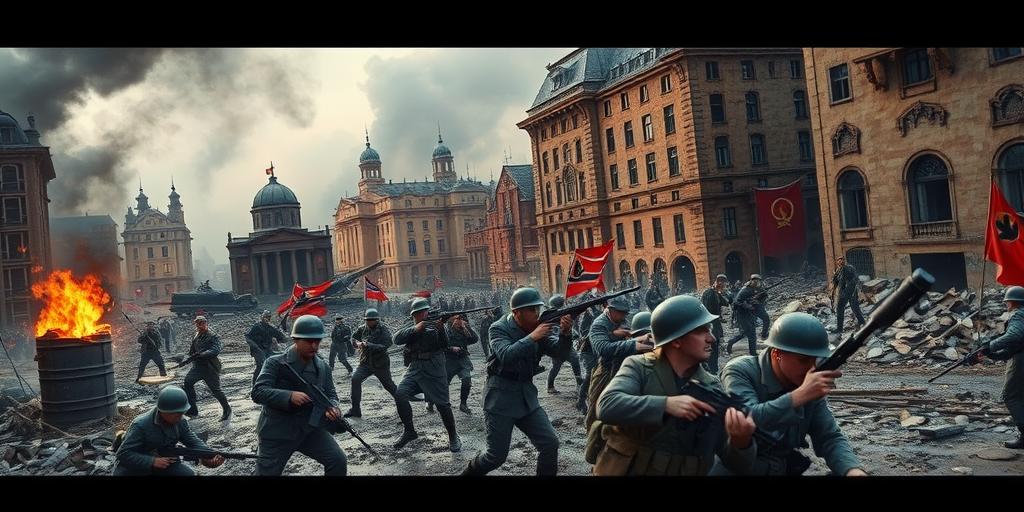
The Battle of Stalingrad, a brutal and pivotal clash on the Eastern Front of World War II, marked a decisive turning point in the conflict. Fought between August 23, 1942, and February 2, 1943, the battle pitted Nazi Germany and its allies against the Soviet Union in a bloody struggle for control of the city of Stalingrad (now Volgograd) in southwestern Russia.
Strategic Importance
Stalingrad held immense strategic value due to its location on the Volga River, a crucial transportation artery linking central Russia with the oil-rich regions of the Caucasus. Capturing the city would sever this vital supply line, crippling the Soviet war effort and opening the door for a German advance deeper into Soviet territory.
The German Offensive
In the summer of 1942, the German Wehrmacht launched Operation Blue, a major offensive aimed at seizing the Caucasus oil fields. As part of this operation, the German 6th Army, under the command of General Friedrich Paulus, advanced on Stalingrad. The initial assault involved relentless aerial bombardment that reduced much of the city to rubble.
Fierce Urban Warfare
As German forces entered Stalingrad, the battle transformed into a savage urban conflict. Fighting took place in the streets, factories, and even within buildings, with soldiers often battling for control of individual rooms. The Soviets, under the command of General Vasily Chuikov, adopted a strategy of 'hugging' the enemy, staying as close as possible to German positions to minimize the effectiveness of German artillery and air power.
The fighting was characterized by its extreme brutality and high casualty rates. Snipers, such as Vasily Zaitsev, became legendary for their deadly accuracy in the ruins of the city. The close-quarters combat and constant shelling created a hellish environment for both sides.
Soviet Counter-Offensive: Operation Uranus
While the Germans were bogged down in Stalingrad, the Soviets were secretly planning a massive counter-offensive. On November 19, 1942, the Soviets launched Operation Uranus, a two-pronged attack that targeted the overextended and under-protected flanks of the German 6th Army. The offensive quickly encircled the German forces inside Stalingrad.
The Encirclement and Relief Attempts
Despite being surrounded, Hitler ordered Paulus and the 6th Army to stand firm and fight to the last man. The Luftwaffe attempted to supply the trapped German forces by air, but the effort was insufficient to meet their needs. A German relief operation, Operation Winter Storm, launched in December 1942, failed to break through the Soviet encirclement.
German Surrender and Aftermath
Starved, exhausted, and overwhelmed, the German 6th Army was eventually forced to surrender. On February 2, 1943, the last German forces in Stalingrad capitulated, marking a catastrophic defeat for Nazi Germany. The Battle of Stalingrad was one of the bloodiest battles in human history, with estimated casualties of nearly two million people, including soldiers and civilians.
Turning the Tide
The Battle of Stalingrad was a major turning point in World War II. It marked the end of German advances in the East and the beginning of the Soviet Union's long and arduous push westward, ultimately leading to the defeat of Nazi Germany in 1945. The victory at Stalingrad boosted Soviet morale and demonstrated the Red Army's growing strength and resilience.


