
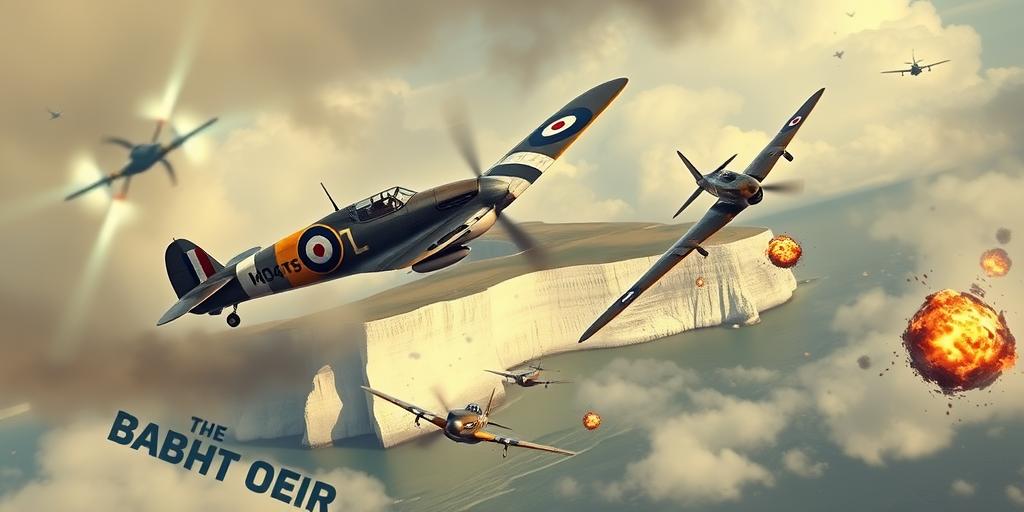
The Battle of Britain: How RAF Pilots Saved an Island Nation
The Battle of Britain, fought in the skies above the United Kingdom during the summer and autumn of 1940, stands as a pivotal moment in World War II. It was the first major campaign fought entirely in the air, pitting the Royal Air Force (RAF) against the German Luftwaffe in a struggle for control of British airspace. The outcome would not only determine the fate of Britain but also influence the course of the war itself.
Prelude to Battle
Following the rapid fall of France in June 1940, Britain stood alone against Nazi Germany. Hitler planned Operation Sea Lion, the invasion of Britain, but it could only proceed if the Luftwaffe gained air superiority. Thus began the Battle of Britain, a relentless aerial assault aimed at crippling the RAF and paving the way for invasion.
The Opposing Forces
The Luftwaffe possessed a numerical advantage, boasting a larger and more experienced air fleet. Key aircraft included the Messerschmitt Bf 109 and Bf 110 fighters, as well as various bombers like the Heinkel He 111 and Junkers Ju 88. However, the RAF had its own strengths. The Supermarine Spitfire and Hawker Hurricane fighters were formidable adversaries, and the British also benefited from a robust radar system (Chain Home) that provided early warnings of incoming German raids.
The Battle Unfolds
The Battle of Britain can be divided into several phases:
- The Channel Battles (July 10 – August 11, 1940): The Luftwaffe initially targeted British shipping in the English Channel to draw out and weaken the RAF's Fighter Command.
- Attacks on RAF Airfields (August 12 – September 6, 1940): The Luftwaffe shifted its focus to destroying RAF airfields and infrastructure, aiming to cripple the RAF's ability to respond.
- The Battle Peaks (September 7 – September 30, 1940): In a strategic blunder, the Luftwaffe began bombing London, diverting its attacks from the airfields. This gave the RAF crucial time to recover and reorganize.
- Night Blitz (October 1940 – May 1941): Unable to achieve air superiority, the Luftwaffe resorted to night bombing raids on British cities.
Key Factors in the RAF's Victory
Several factors contributed to the RAF's ultimate victory:
- The Supermarine Spitfire and Hawker Hurricane: These aircraft were more than a match for their German counterparts. The Spitfire, in particular, was vital for intercepting enemy fighters.
- Radar (Chain Home): This advanced radar system provided early warnings of incoming German raids, allowing the RAF to scramble fighters and intercept the enemy.
- Ground Control: A sophisticated ground control system coordinated the RAF fighters, directing them to intercept the enemy at the most opportune moments.
- Pilot Skill and Determination: The RAF pilots, many of whom were young and relatively inexperienced, fought with incredible courage and determination.
- Home Advantage: Fighting over their own territory, the RAF pilots benefited from shorter flight times and the knowledge of the local terrain.
The Significance of the Battle
The Battle of Britain was a decisive victory for the Allies. It prevented the invasion of Britain, allowing the country to serve as a base for future Allied operations. The battle also demonstrated the importance of air power and boosted British morale during a dark period of the war. The courage and resilience of the RAF pilots, often referred to as "The Few" (a reference to Winston Churchill's famous quote, "Never in the field of human conflict was so much owed by so many to so few"), became a symbol of British defiance and played a crucial role in turning the tide of World War II. The Battle of Britain remains a testament to the courage, skill, and determination of the RAF pilots who saved an island nation from invasion.


