
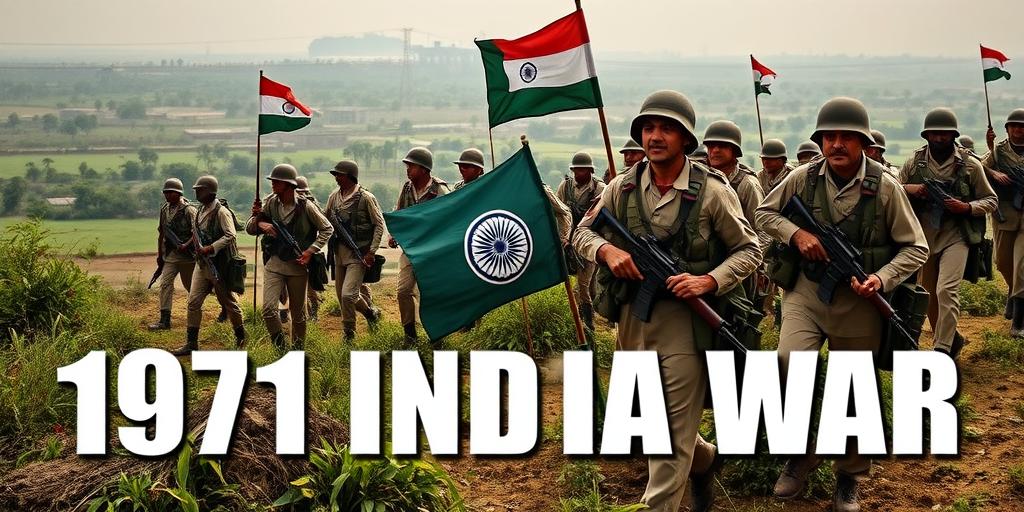
The 1971 Indo-Pak War remains a pivotal event in South Asian history, reshaping the geopolitical landscape and leading to the creation of Bangladesh. While the conflict involved direct military engagement between India and Pakistan, the role of the Mukti Bahini, the Bengali liberation force, was instrumental in the war's outcome. This post examines the Mukti Bahini's contribution, the key events of the war, and its lasting geopolitical consequences.
The Genesis of the Mukti Bahini
The seeds of the 1971 war were sown in the political and cultural tensions following the partition of India in 1947. East Pakistan, despite having a larger population, faced political and economic marginalization by the West Pakistani elite. The Awami League, led by Sheikh Mujibur Rahman, emerged as the primary voice for Bengali rights. In the 1970 elections, the Awami League won a clear majority, but West Pakistan's leaders refused to cede power.
This sparked widespread protests in East Pakistan, which were met with brutal suppression by the Pakistani military. Operation Searchlight, launched on March 25, 1971, targeted Bengali intellectuals, students, and political activists, leading to a massive refugee crisis as millions fled to India. In response, the Mukti Bahini was formed to resist the Pakistani forces and fight for the independence of East Pakistan.
Mukti Bahini: Organization and Operations
The Mukti Bahini comprised a combination of Bengali military personnel, paramilitary forces, and civilian volunteers. It was organized into several sectors, each responsible for specific regions within East Pakistan. Initially, the Mukti Bahini relied on guerrilla tactics, targeting Pakistani military installations, supply lines, and communication networks. They received training and support from India, which played a crucial role in bolstering their capabilities.
As the conflict escalated, the Mukti Bahini's operations became more coordinated and effective. They worked closely with the Indian Army, providing valuable intelligence and logistical support. Their knowledge of the local terrain and the support of the Bengali population were invaluable assets in the war effort. The Mukti Bahini's relentless attacks weakened the Pakistani military, paving the way for India's direct intervention.
India's Intervention and the War's Climax
By late 1971, the situation in East Pakistan had deteriorated significantly, with widespread human rights abuses and a growing humanitarian crisis. India, under Prime Minister Indira Gandhi, had been providing refuge to millions of Bengali refugees and had been advocating for a political solution. However, Pakistan's continued military crackdown and cross-border shelling prompted India to intervene militarily.
On December 3, 1971, Pakistan launched preemptive air strikes on Indian airfields, triggering a full-scale war. The Indian military, in coordination with the Mukti Bahini, launched a swift and decisive campaign. The Mukti Bahini played a key role in liberating key areas, disrupting Pakistani troop movements, and maintaining civilian morale. The Indian Army's superior firepower and strategic planning, combined with the Mukti Bahini's local knowledge, led to a rapid collapse of Pakistani defenses.
On December 16, 1971, Pakistani forces in East Pakistan surrendered, marking the end of the war and the birth of Bangladesh. The Mukti Bahini's contribution to this victory cannot be overstated. They not only fought bravely but also played a critical role in mobilizing the Bengali population and providing essential support to the Indian military.
Geopolitical Fallout
The 1971 Indo-Pak War had far-reaching geopolitical consequences. The creation of Bangladesh altered the balance of power in South Asia. It demonstrated India's emergence as a regional power and its willingness to use military force to protect its interests and uphold humanitarian principles. The war also led to a period of improved relations between India and Bangladesh, characterized by close cooperation in various fields.
For Pakistan, the loss of East Pakistan was a major setback. It not only resulted in a significant loss of territory and resources but also undermined the country's ideological foundation. The war exposed the deep-seated ethnic and linguistic divisions within Pakistan and led to a period of political instability.
The 1971 war also had broader implications for the Cold War dynamics. The United States, which had close ties with Pakistan, found itself at odds with India, which had the support of the Soviet Union. The war highlighted the complexities of Cold War alliances and the potential for regional conflicts to escalate into larger geopolitical crises.
Conclusion
The 1971 Indo-Pak War was a watershed moment in South Asian history. The Mukti Bahini's role in the war was pivotal, demonstrating the power of popular resistance and the determination of the Bengali people to achieve independence. The war's outcome not only led to the creation of Bangladesh but also reshaped the geopolitical landscape of the region, with lasting implications for India, Pakistan, and the broader international community. Understanding the Mukti Bahini's contribution is essential for comprehending the complex history and dynamics of South Asia.


