
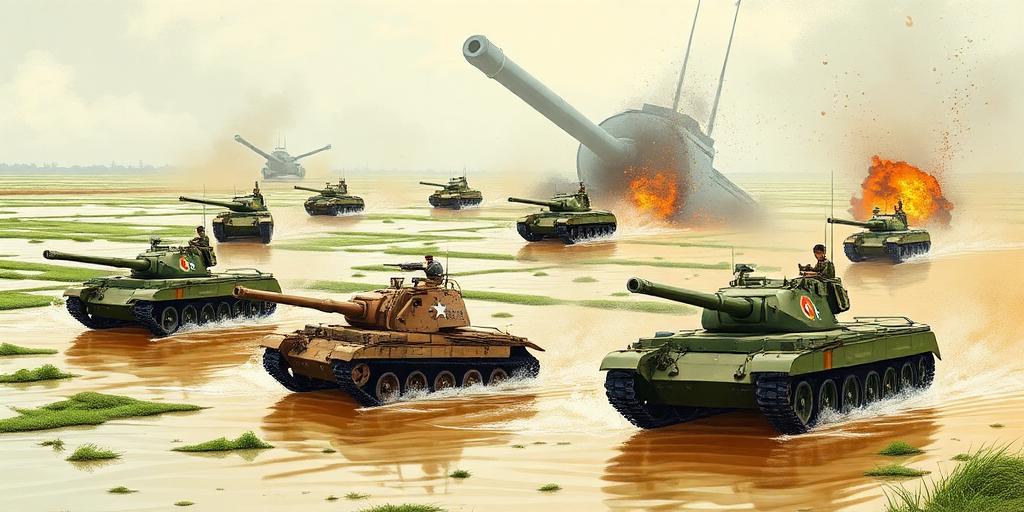
The 1965 Indo-Pak War was a pivotal conflict in the history of the Indian subcontinent, marked by intense battles and strategic maneuvers. Among these, Operation Grand Slam and the Battle of Asal Uttar stand out as critical events that significantly shaped the war's outcome.
Operation Grand Slam: Pakistan's Ambition
Launched on September 1, 1965, Operation Grand Slam was Pakistan's ambitious plan to capture the vital Akhnoor bridge in Jammu and Kashmir. The aim was to cut off Indian supply lines and potentially seize control of the region. Spearheaded by Pakistan's 12th Infantry Division and supported by armored regiments, the offensive initially made rapid gains against the outnumbered Indian forces.
The Pakistani forces advanced swiftly, causing considerable damage and forcing the Indian troops to retreat. The offensive threatened to isolate the entire Indian presence in the Poonch-Rajouri sector. However, the Indian Army, under immense pressure, managed to slow down the Pakistani advance, buying crucial time for reinforcements to arrive.
The Battle of Asal Uttar: India's Stand
As the Pakistani forces pushed deeper into Indian territory, the Battle of Asal Uttar became a decisive turning point. Fought between September 8 and September 10, 1965, this battle saw the Indian Army, led by General Harbaksh Singh and Brigadier Kuldip Singh Chandpuri, strategically lure Pakistani tanks into a horseshoe-shaped area near the village of Asal Uttar, which translates to 'real answer.'
The Indian forces flooded the fields, creating a quagmire that immobilized many Pakistani tanks. This tactical move, combined with effective anti-tank fire, resulted in heavy losses for the Pakistani armored division. Approximately 120 Pakistani tanks were destroyed or captured, crippling their offensive capabilities. The battle is often dubbed as the 'Graveyard of Pakistani Tanks.'
Strategic Impact and Significance
The failure of Operation Grand Slam and the resounding victory at the Battle of Asal Uttar had far-reaching consequences. The Indian Army successfully thwarted Pakistan's attempt to capture Akhnoor and significantly degraded Pakistan's armored strength. This not only stabilized the situation in the Jammu and Kashmir sector but also shifted the momentum of the war in India's favor.
The 1965 Indo-Pak War ultimately ended in a stalemate, with both sides claiming victory. However, the events of Operation Grand Slam and the Battle of Asal Uttar underscored the strategic importance of armored warfare and tactical planning. They remain significant case studies in military history, illustrating how decisive actions can alter the course of a conflict.
Conclusion
The 1965 Indo-Pak War was a complex and intense conflict, with Operation Grand Slam and the Battle of Asal Uttar serving as critical episodes. These events not only highlight the military strategies employed by both sides but also underscore the enduring impact of leadership, tactical acumen, and the resilience of the forces involved. The lessons learned from this war continue to influence military thinking and strategic planning in the region.


