
Operation Overlord: The Planning and Execution of D-Day
Operation Overlord, the codename for the Battle of Normandy, remains one of the most ambitious and pivotal military operations in history. Launched on June 6, 1944, D-Day marked the beginning of the Allied liberation of Western Europe from Nazi occupation during World War II. This post explores the intricate planning, strategic decisions, and the execution of this monumental undertaking.
The Genesis of Overlord: Planning the Unprecedented
The seeds of Operation Overlord were sown years before the actual invasion. Following the evacuation of Dunkirk in 1940 and the subsequent fall of France, it became clear to the Allied forces that a direct assault on mainland Europe was necessary to defeat Nazi Germany. The planning phase involved:
- Strategic Objectives: Defining clear goals, including securing a beachhead, establishing supply lines, and pushing inland to liberate key territories.
- Selecting the Location: Choosing Normandy as the landing site after evaluating various factors such as proximity to England, defenses, and terrain.
- Resource Allocation: Mobilizing massive amounts of manpower, equipment, and logistical support from multiple Allied nations.
Key figures such as General Dwight D. Eisenhower, who served as the Supreme Commander of the Allied Expeditionary Force, and General Bernard Montgomery, who commanded the ground forces, played crucial roles in shaping the operational strategy.
Deception and Intelligence: Misleading the Enemy
A critical aspect of Operation Overlord was deceiving the German forces about the Allies' true intentions. Operation Bodyguard, a large-scale deception plan, aimed to mislead the Germans regarding the location, timing, and scale of the invasion. Key components included:
- Operation Fortitude: Creating a fictitious army group, supposedly based in southeastern England and preparing to invade Pas-de-Calais, the area closest to England.
- Double Agents: Using captured German agents to feed false information to the German high command.
- Aerial Reconnaissance: Conducting reconnaissance missions to gather intelligence on German defenses and troop movements.
These efforts successfully diverted German attention away from Normandy, weakening their defenses and contributing to the success of the initial landings.
D-Day: The Assault on Normandy
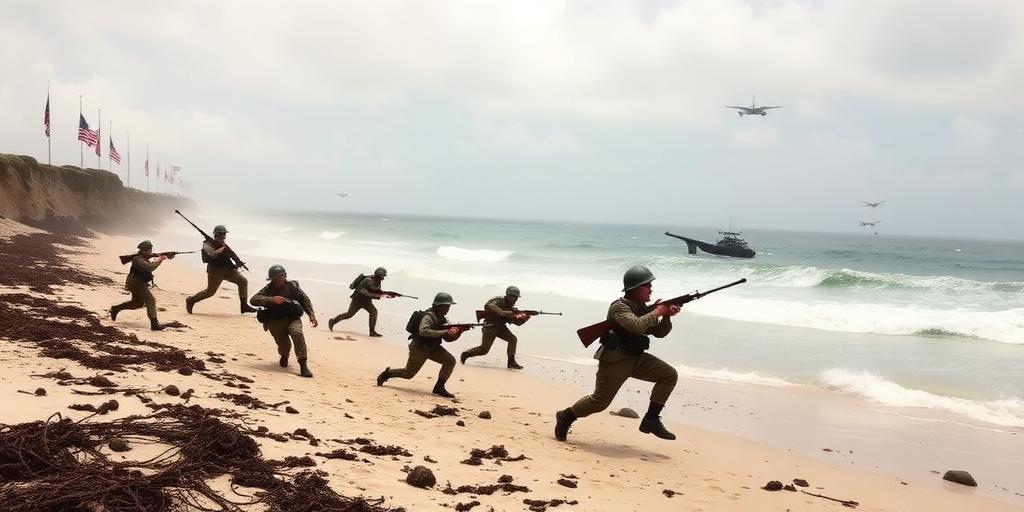
On June 6, 1944, under the cover of darkness, thousands of Allied paratroopers and glider troops were dropped behind enemy lines to secure key bridges and disrupt German communications. Simultaneously, a massive naval armada approached the Normandy coast. The assault was divided into five sectors:
- Utah and Omaha (United States): Facing fierce resistance, particularly at Omaha Beach, where heavy casualties were sustained.
- Gold and Sword (United Kingdom): Encountering strong defenses but ultimately securing their objectives.
- Juno (Canada): Successfully landing and pushing inland, overcoming significant obstacles.
The initial hours of the invasion were chaotic, with heavy fighting along the beaches. However, the Allied forces gradually gained ground, establishing a foothold in Normandy.
The Aftermath: Securing Normandy and Beyond
Following the D-Day landings, the Battle of Normandy continued for several weeks as the Allied forces fought to expand their beachhead and break through German defenses. Key events included:
- The Battle of Caen: A prolonged and costly struggle to capture the strategically important city of Caen.
- Operation Cobra: A major offensive launched in late July to break through German lines and advance into France.
- The Falaise Pocket: Encircling and destroying a large number of German troops, effectively crippling their ability to resist.
By the end of August 1944, the Allied forces had liberated Normandy and were advancing towards Paris. Operation Overlord had achieved its primary objectives, paving the way for the liberation of Western Europe and the eventual defeat of Nazi Germany.
Conclusion
Operation Overlord stands as a testament to the power of strategic planning, international cooperation, and the courage of the Allied forces. The success of D-Day not only changed the course of World War II but also laid the foundations for a new era of peace and prosperity in Europe. The lessons learned from this historic operation continue to influence military strategy and international relations to this day.


