
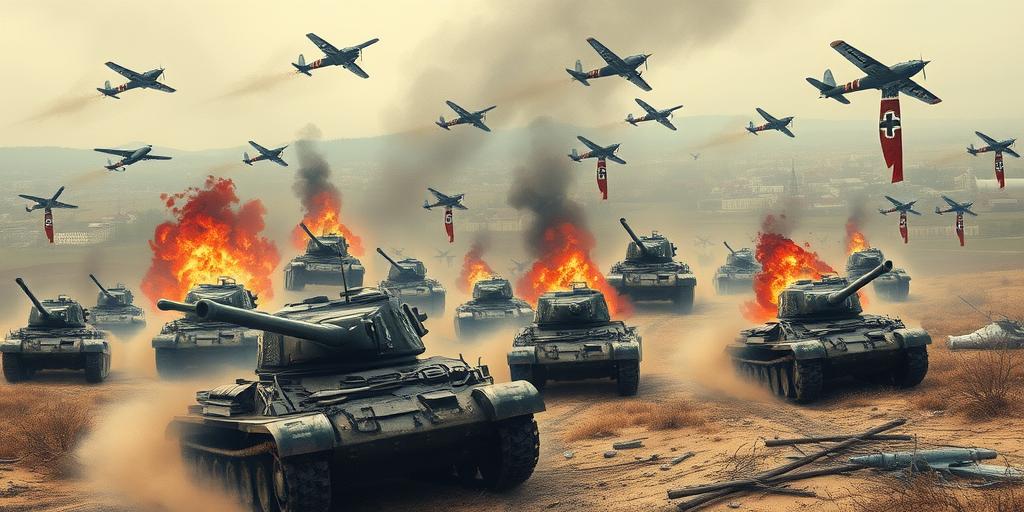
On September 1, 1939, Nazi Germany launched a full-scale invasion of Poland, an act that ignited World War II. This event was the culmination of years of rising tensions in Europe, driven by Adolf Hitler's expansionist ambitions and the failure of appeasement by other European powers.
Background to the Invasion
Following the Treaty of Versailles after World War I, Poland regained its independence, which included territories that were previously part of Germany. This territorial restructuring created a lingering sense of resentment among many Germans, exploited by Hitler and the Nazi party to rally support for their cause.
Hitler's strategy of territorial expansion began with the annexation of Austria in 1938, followed by the occupation of Czechoslovakia in early 1939. These actions demonstrated his disregard for international agreements and the sovereignty of other nations. Poland became the next target due to its strategic location and the presence of German-populated territories, particularly the city of Danzig and the Polish Corridor, which separated East Prussia from the rest of Germany.
The Invasion Plan and Execution
The invasion was meticulously planned under the codename Fall Weiss (Case White). It involved a coordinated assault by land and air. The German military, or Wehrmacht, deployed over 1.5 million soldiers, thousands of tanks, and hundreds of aircraft.
The Luftwaffe, the German air force, initiated the attack by bombing Polish cities and military installations, crippling Poland's ability to mobilize effectively. Simultaneously, German armored divisions and infantry advanced rapidly into Polish territory, employing Blitzkrieg tactics – a 'lightning war' that combined swift movement and concentrated firepower to overwhelm the enemy.
Polish Resistance
Despite being outmatched, the Polish army mounted a fierce defense. Polish soldiers fought bravely, often against overwhelming odds. Key battles took place at Westerplatte, where a small Polish garrison held out against German forces for seven days, and at the Bzura River, where the Polish launched a counteroffensive that briefly stalled the German advance.
However, the Polish forces were ultimately unable to withstand the combined might of the German military. Poor coordination, outdated equipment, and the lack of support from Western allies contributed to their defeat.
International Response
Prior to the invasion, Britain and France had pledged to defend Poland in the event of an attack. On September 3, 1939, two days after the invasion, both countries declared war on Germany, marking the official beginning of World War II. However, their response was limited to symbolic gestures and a naval blockade of Germany, with no immediate military assistance to Poland.
Consequences of the Invasion
The invasion of Poland had devastating consequences for the Polish people. Poland was divided between Germany and the Soviet Union under the Molotov-Ribbentrop Pact, a non-aggression agreement between the two powers. The Nazi regime implemented a brutal occupation policy, targeting Polish intellectuals, political leaders, and Jews for extermination.
The invasion also altered the course of world history. It marked the failure of appeasement and demonstrated the aggressive nature of Nazi Germany. The conflict quickly escalated into a global war, drawing in nations from around the world and resulting in millions of casualties and widespread destruction.
In summary, the invasion of Poland by Nazi Germany on September 1, 1939, was a pivotal event that triggered World War II. Driven by Hitler's expansionist ambitions, the invasion was executed with ruthless efficiency, overwhelming the Polish defenses and leading to a brutal occupation. The international community's response marked the beginning of a global conflict that would reshape the world.


