
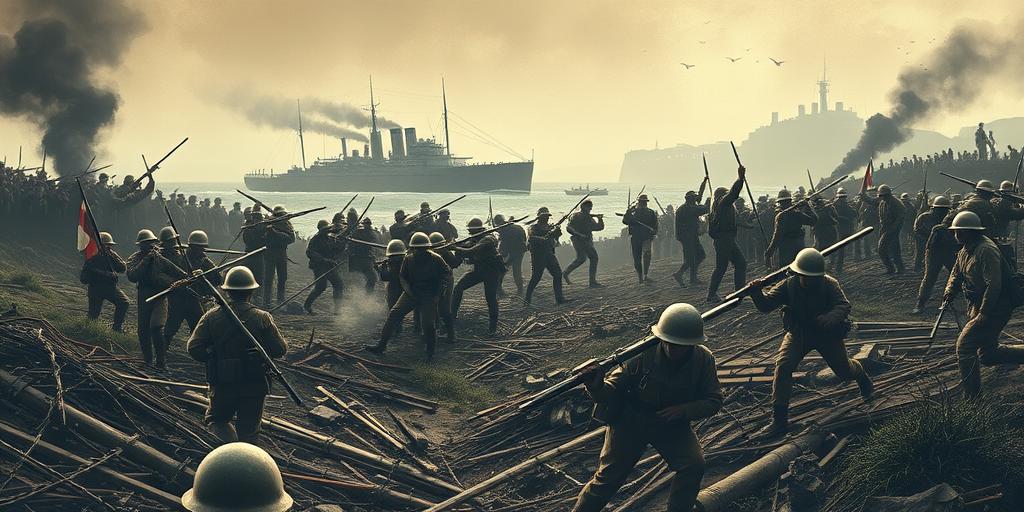
Gallipoli Campaign Re-examined: Churchill's Folly or Strategic Necessity?
The Gallipoli Campaign, a joint British and French operation in 1915 aimed at capturing the Ottoman capital of Constantinople (now Istanbul) and securing a sea route to Russia, remains one of the most controversial and debated episodes of World War I. Often labeled 'Churchill's Folly,' due to the prominent role of Winston Churchill, then First Lord of the Admiralty, the campaign's strategic rationale, execution, and ultimate failure continue to be scrutinized by historians and military analysts alike.
Strategic Context
In the early months of World War I, the Allied powers sought to break the stalemate on the Western Front. Russia, a key ally, faced increasing difficulties in receiving supplies through its northern ports, which were often ice-bound or threatened by German naval activity. The Dardanelles Strait, controlled by the Ottoman Empire, presented a potential solution. Opening this route would allow the Allies to resupply Russia, knock the Ottoman Empire out of the war, and potentially influence the Balkan states to join the Allied cause.
Churchill's Vision
Winston Churchill championed the Gallipoli operation with considerable enthusiasm. He envisioned a swift naval assault to force the Dardanelles, followed by the capture of Constantinople. Churchill argued that a successful campaign would not only relieve pressure on the Eastern Front but also reshape the entire geopolitical landscape of the war. His initial plan involved using older battleships to bombard Ottoman fortifications along the Dardanelles, gradually clearing the way for Allied ships to enter the Sea of Marmara.
The Naval Failure
The naval assault commenced on February 19, 1915. While initial bombardments achieved some success, the Ottoman defenses, particularly the minefields laid by the Ottoman navy, proved more resilient than anticipated. On March 18, a major naval offensive was launched, but it ended in disaster. Several Allied battleships were sunk or severely damaged by mines and artillery fire, forcing the Allies to abandon the naval assault. This failure underscored the underestimation of Ottoman strength and the overreliance on naval power alone.
The Land Campaign
Following the naval setback, the Allies decided to launch a land invasion of the Gallipoli Peninsula. On April 25, 1915, British, French, Australian, and New Zealand troops landed at various points along the peninsula. The landings were met with fierce resistance from the Ottoman army, led by Mustafa Kemal (later Atatürk). The Allied troops faced difficult terrain, intense heat, and a determined enemy. The campaign quickly devolved into trench warfare, similar to the Western Front, with neither side able to achieve a decisive breakthrough.
Reasons for Allied Failure
Several factors contributed to the Allied failure at Gallipoli:
- Underestimation of Ottoman Strength: The Allies underestimated the Ottoman army's capabilities and determination. The Ottoman soldiers, fighting on their home soil, were highly motivated and well-led.
- Poor Planning and Coordination: The Allied campaign was plagued by poor planning, inadequate intelligence, and a lack of coordination between the various national contingents.
- Difficult Terrain and Climate: The rugged terrain of the Gallipoli Peninsula and the harsh climate conditions made military operations extremely challenging.
- Inadequate Equipment and Supplies: The Allied troops often lacked the necessary equipment and supplies to sustain a prolonged campaign.
- Effective Ottoman Defense: The Ottoman forces, under the command of Mustafa Kemal, employed effective defensive tactics, including the use of trenches, barbed wire, and artillery.
Consequences and Legacy
In late 1915, after months of heavy casualties and no significant gains, the Allies decided to evacuate Gallipoli. The evacuation was completed in December 1915 and January 1916. The Gallipoli Campaign was a costly failure for the Allies, resulting in hundreds of thousands of casualties. It also had significant political and strategic consequences:
- Strengthened Ottoman Empire: The successful defense of Gallipoli boosted the morale and prestige of the Ottoman Empire, prolonging its involvement in World War I.
- Damaged Churchill's Reputation: The failure of the Gallipoli Campaign severely damaged Winston Churchill's reputation, leading to his temporary removal from government.
- Rise of Mustafa Kemal: The campaign elevated Mustafa Kemal to national hero status in Turkey, paving the way for his leadership in the Turkish War of Independence and the establishment of the modern Republic of Turkey.
- Australian and New Zealand Identity: The Gallipoli Campaign became a defining moment in the national identities of Australia and New Zealand. The courage and sacrifice of the Australian and New Zealand Army Corps (ANZAC) troops are commemorated annually on ANZAC Day.
Churchill's Folly or Strategic Necessity?
Was the Gallipoli Campaign a strategic necessity or simply 'Churchill's Folly'? The answer is complex and depends on one's perspective. Strategically, the campaign aimed to achieve significant objectives, such as relieving pressure on Russia and knocking the Ottoman Empire out of the war. However, the execution of the campaign was flawed, marked by underestimation of the enemy, poor planning, and inadequate resources.
While Churchill's enthusiasm and advocacy for the campaign are undeniable, attributing the failure solely to him is an oversimplification. The Gallipoli Campaign was a collective effort involving multiple actors and factors. Ultimately, it was a high-risk gamble that failed to pay off, resulting in immense human cost and strategic disappointment. The lessons learned from Gallipoli continue to be studied by military strategists and historians, serving as a reminder of the complexities and uncertainties of warfare.


