
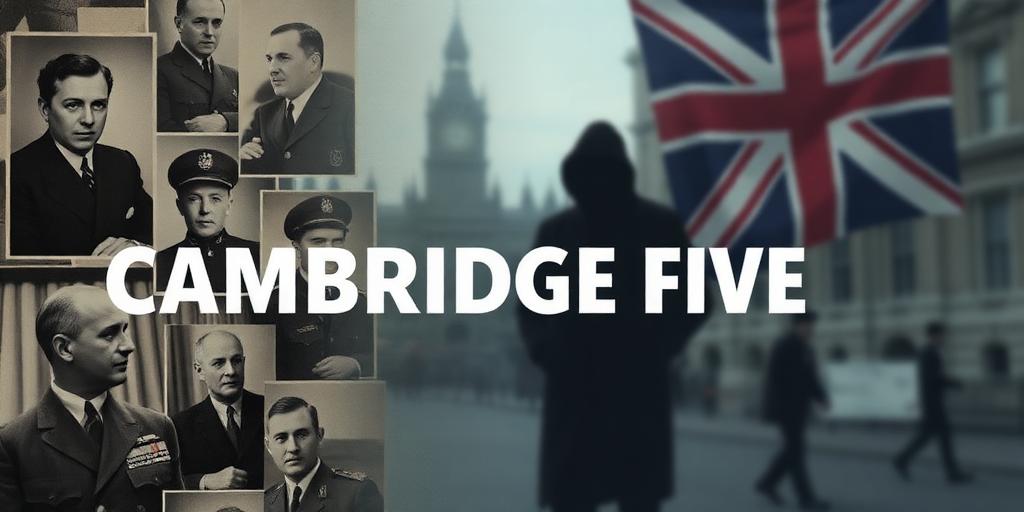
The Cambridge Five: Traitors in the Heart of British Intelligence
The Cold War was a battle fought on many fronts, but few were as shadowy and dangerous as the world of espionage. Among the most infamous figures in this clandestine conflict were the Cambridge Five, a group of British intellectuals recruited by Soviet intelligence who rose to prominence in British intelligence and the Foreign Office. Their betrayal had a profound and lasting impact on Anglo-American relations and the course of the Cold War.
Recruitment and Early Careers
The Cambridge Five consisted of Kim Philby, Donald Maclean, Guy Burgess, Anthony Blunt, and John Cairncross. Recruited in the 1930s while students at Cambridge University, they were drawn to communism by their disillusionment with capitalism and the rise of fascism in Europe. Their handlers in the Soviet intelligence services recognized their potential and cultivated them as long-term assets.
- Kim Philby: Arguably the most successful of the five, Philby joined the British Secret Intelligence Service (MI6) after the war. He rose through the ranks, eventually heading the section responsible for counter-intelligence against the Soviet Union. This gave him access to highly sensitive information, which he regularly passed on to his Soviet handlers.
- Donald Maclean: Maclean joined the Foreign Office and held various diplomatic posts in Paris and Washington. His position provided him with access to top-secret information about Western policy and nuclear strategy, all of which he shared with the Soviets.
- Guy Burgess: Outspoken and flamboyant, Burgess worked for the BBC and later joined the Foreign Office. His charm and social connections allowed him to gather intelligence from a wide range of sources. He was known for his indiscreet behavior, which eventually raised suspicions about his loyalty.
- Anthony Blunt: A respected art historian, Blunt held a position as Surveyor of the King's Pictures. He also worked for MI5, the British Security Service, during the war. Blunt used his position to pass on intelligence to the Soviets and to protect his fellow spies from exposure.
- John Cairncross: Cairncross worked at the Government Code and Cypher School at Bletchley Park during the war, where he had access to decrypted German communications. He later joined the Treasury and continued to provide the Soviets with valuable intelligence.
Years of Espionage
For years, the Cambridge Five operated with impunity, providing the Soviet Union with a steady stream of classified information. Their betrayal allowed the Soviets to anticipate Western policy decisions, undermine Western intelligence operations, and gain a significant advantage in the Cold War. They were able to do so because they had been thoroughly vetted by British Intelligence and were trusted implicitly by their superiors.
Their actions directly led to the deaths of numerous Western agents operating behind the Iron Curtain, as the Soviets were able to identify and capture them thanks to the information provided by the Cambridge Five. They also compromised several intelligence operations, causing significant damage to Western interests.
Exposure and Defection
The first crack in the Cambridge Five's facade appeared in 1951 when Maclean was identified as a potential spy. Burgess accompanied him on his flight to Moscow, alerting the British authorities to the scale of the betrayal. Philby's involvement was suspected, but he managed to deflect suspicion and remain in place for several more years.
Philby eventually defected to Moscow in 1963, after being confronted with mounting evidence of his treachery. Blunt was exposed in 1964 but was granted immunity from prosecution in exchange for confessing his role and providing information about the other members of the network. Cairncross was also eventually unmasked and confessed to his involvement.
Legacy and Impact
The exposure of the Cambridge Five sent shockwaves through British intelligence and the government. It damaged Anglo-American relations, as the Americans questioned the security of British intelligence and their ability to safeguard classified information. It led to a series of investigations and reforms aimed at tightening security and preventing future betrayals.
The Cambridge Five remain a symbol of the treachery and deception that characterized the Cold War. Their story serves as a cautionary tale about the dangers of ideological extremism and the importance of vigilance in the face of espionage. The damage they inflicted on Western interests was immense, and their actions continue to be studied and debated to this day.


