
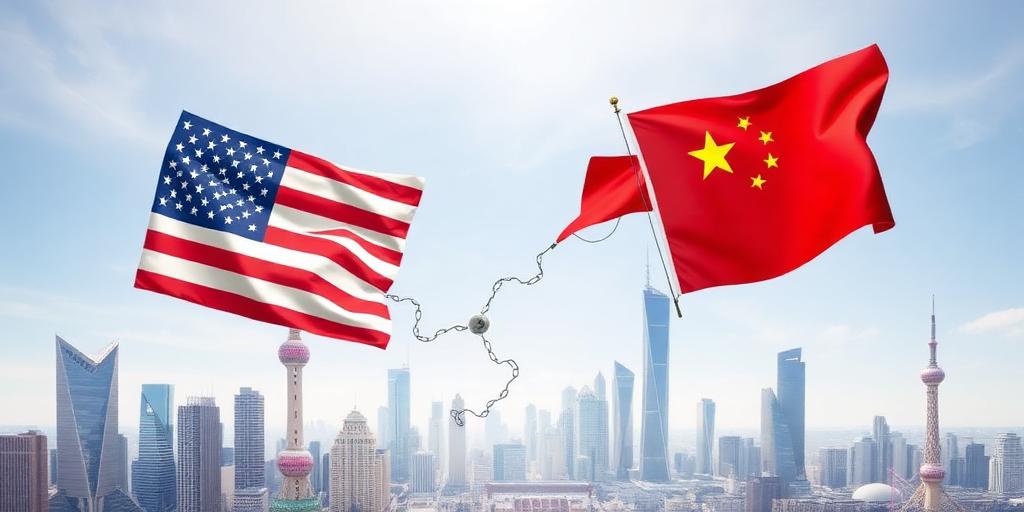
US-China Decoupling: Myth or an Accelerating Economic Reality?
The relationship between the United States and China has become increasingly complex in recent years, marked by trade disputes, technological competition, and geopolitical tensions. A central question emerging from this dynamic is whether the two economic superpowers are heading towards decoupling—a severing of economic ties—or if this notion is merely a hypothetical scenario.
What is Economic Decoupling?
Economic decoupling refers to a situation where two countries significantly reduce their economic interdependence. This can manifest in various forms, including decreased trade, investment, and technological collaboration. In the context of the US and China, decoupling would mean a deliberate effort to disentangle their deeply interwoven economies.
Arguments for Decoupling as a Myth
- Deep Interdependence: The US and Chinese economies are deeply integrated. Supply chains are intricately linked, with many US companies relying on China for manufacturing and raw materials. Chinese consumers represent a significant market for US goods and services. Untangling these links would be a complex and costly undertaking.
- Economic Costs: Decoupling would likely result in significant economic costs for both countries. US companies would need to find alternative supply chains, potentially leading to higher production costs and reduced competitiveness. China would need to find new markets for its exports and new sources of technology and investment.
- Global Impact: A full-scale decoupling could destabilize the global economy. It could disrupt trade flows, create uncertainty for businesses, and potentially lead to slower global growth.
Evidence Suggesting Decoupling is Accelerating
- Trade War: The trade war initiated by the US in 2018, with tariffs imposed on billions of dollars’ worth of Chinese goods, marked a significant step towards decoupling. While a phase-one trade deal was signed in 2020, many tariffs remain in place, and tensions persist.
- Technology Restrictions: The US has placed restrictions on Chinese technology companies, citing national security concerns. Companies like Huawei have been targeted with export controls, limiting their access to US technology. This has led to a push within China to develop indigenous technologies and reduce reliance on foreign suppliers.
- Reshoring and Diversification: There is a growing trend among US companies to reshore manufacturing operations or diversify their supply chains away from China. This is driven by concerns about geopolitical risk, supply chain resilience, and the desire to reduce dependence on a single source.
- Geopolitical Tensions: Rising tensions over issues such as Taiwan, the South China Sea, and human rights have further strained relations between the US and China. These tensions create a climate of uncertainty that encourages businesses to reduce their exposure to China.
The Reality: Selective Decoupling
While a complete decoupling of the US and Chinese economies appears unlikely and undesirable, a more selective form of decoupling seems to be underway. This involves:
- Strategic Sectors: Focusing on decoupling in strategic sectors such as technology, defense, and critical infrastructure.
- Supply Chain Resilience: Diversifying supply chains to reduce reliance on China for essential goods.
- Technology Competition: Intensifying competition in key technologies, with both countries seeking to establish dominance in areas like artificial intelligence, 5G, and semiconductors.
Conclusion
The notion of a complete US-China decoupling may be overstated. The economic interdependence between the two countries is a strong deterrent. However, growing tensions and strategic considerations are driving a selective decoupling, particularly in sensitive sectors. This trend is likely to continue, reshaping the global economic landscape and creating new challenges and opportunities for businesses and policymakers alike.


