
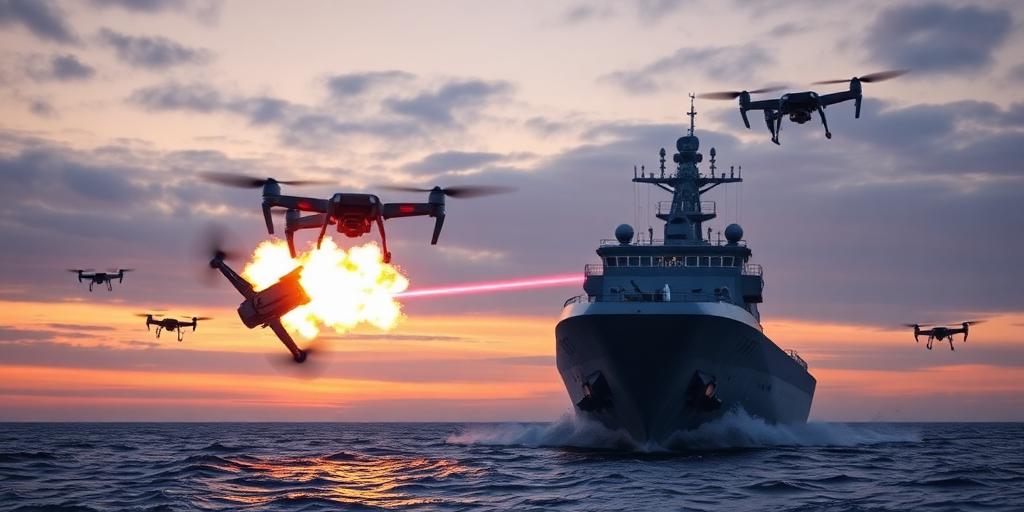
Naval Laser Systems: Countering Drones and Small Boat Threats
The modern maritime environment faces increasingly complex threats, from unmanned aerial vehicles (UAVs) to fast-attack craft. Traditional kinetic solutions, while effective, can be costly and logistically challenging to deploy against these asymmetric threats. Naval laser systems offer a potentially transformative solution, providing a layered defense capability with precision engagement, scalability, and reduced cost per engagement.
What are Naval Laser Systems?
Naval laser systems, also known as directed energy weapons (DEWs), utilize high-energy lasers to disable or destroy targets at a distance. These systems typically consist of the following components:
- Laser Source: Generates the high-energy laser beam. Solid-state lasers, fiber lasers, and chemical lasers are among the technologies used.
- Beam Control System: Precisely directs and focuses the laser beam onto the target. This includes sophisticated optics and tracking systems.
- Power and Cooling Systems: High-energy lasers require significant power and generate substantial heat, necessitating robust power and thermal management systems.
- Command and Control System: Integrates the laser system with the ship's sensors and fire control systems, enabling target identification, tracking, and engagement.
Benefits of Naval Laser Systems
Naval laser systems offer several advantages over traditional kinetic weapons:
- Precision Engagement: Lasers can deliver precise and localized effects, minimizing collateral damage.
- Scalability: Laser power can be adjusted to match the threat level, from non-lethal disruption to complete destruction.
- Low Cost Per Engagement: Once deployed, the cost per laser shot is significantly lower than that of missiles or other traditional munitions.
- Deep Magazine: Lasers are limited only by the available power and cooling capacity, providing a virtually unlimited magazine depth.
- Speed of Light Delivery: The laser beam reaches the target instantaneously, reducing engagement time and increasing the probability of kill.
Countering Drone Threats
Drones pose a significant threat to naval vessels, both in littoral and open ocean environments. They can be used for reconnaissance, electronic warfare, or even direct attack. Naval laser systems offer an effective counter-UAV capability by:
- Disrupting Sensors: Lasers can blind or damage drone sensors, rendering them ineffective.
- Burning Through Airframes: High-powered lasers can physically damage or destroy drone airframes, causing them to crash.
- Engaging Swarms: Lasers can rapidly engage multiple drones simultaneously, providing a defense against swarm attacks.
Countering Small Boat Threats
Small, fast-attack craft represent another significant threat to naval vessels, particularly in coastal areas. These boats can be armed with explosives or missiles and used to conduct asymmetric attacks. Naval laser systems can counter small boat threats by:
- Disabling Engines: Lasers can damage or destroy boat engines, disabling them.
- Igniting Fuel: Lasers can ignite fuel tanks, causing fires and explosions.
- Neutralizing Personnel: Lasers can be used to incapacitate or neutralize personnel on board the boat.
Challenges and Future Developments
Despite their many advantages, naval laser systems face several challenges:
- Atmospheric Conditions: Atmospheric turbulence, fog, and rain can degrade laser performance.
- Power and Cooling Requirements: High-energy lasers require significant power and cooling capacity, which can be challenging to integrate into existing naval platforms.
- Target Tracking: Accurately tracking and engaging moving targets at long range requires sophisticated sensors and fire control systems.
Future developments in naval laser systems are focused on:
- Increasing Laser Power: Higher power lasers will enable engagement of larger and more distant targets.
- Improving Beam Control: Advanced beam control systems will improve laser accuracy and reduce the impact of atmospheric conditions.
- Developing Compact Systems: Smaller and lighter laser systems will enable integration into a wider range of naval platforms.
- Integrating with Existing Systems: Seamless integration with existing shipboard sensors and fire control systems will maximize effectiveness.
Conclusion
Naval laser systems represent a promising technology for countering drone and small boat threats. Their precision engagement, scalability, and low cost per engagement make them an attractive complement to traditional kinetic weapons. As laser technology continues to mature, naval laser systems are poised to play an increasingly important role in maritime defense.


